Electric ships are often associated with short ferry crossings and harbour operations. But how far can a battery-electric ship actually travel?
There is no single answer. Ships vary enormously in size, speed and operating profile, and those factors have a major impact on energy use.
In practice, two things tend to set the limits.
The first is economics. At what point does the cost of batteries and electrification outweigh the cost of alternative fuels?
The second is technical. How much battery capacity can be installed without compromising the vessel through excessive weight or loss of useful space?
For smaller vessels, those physical constraints can become significant quickly. Larger commercial ships are generally more forgiving, with greater displacement and more available volume. For many medium and large vessels, the economics can become the limiting factor before battery size itself does.
And both sides of that equation are changing quickly.
Marine batteries are getting much larger
The scale of marine battery systems has increased dramatically over the past decade.
Norway’s Ampere, one of the vessels that helped establish modern battery-electric ferry operations in 2015, carried a battery of around 1 MWh.
Today, Incat’s 130 metre China Zorrilla, built in Tasmania for Buquebus, carries more than 40 MWh.
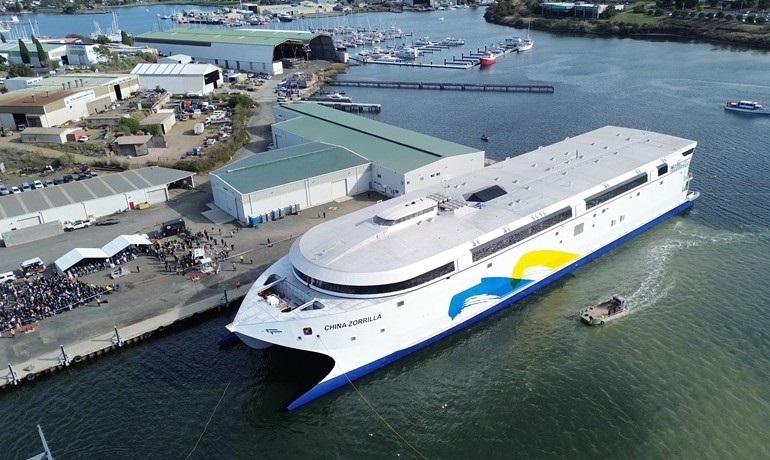
Image: China Zorrilla - 40MWh Fully Electric Ferry - Built by Incat Tasmania (Photo Copyright Incat)
The next step is already underway. New fully electric short-sea containerships are being developed with battery systems above 100 MWh and planned ranges of around 500 to 600 nautical miles.
For context, 100 MWh is roughly equivalent to the combined battery capacity of around 1,500 electric cars, and is comparable in scale to a grid battery energy storage system.
That is a major change in little more than a decade.
Speed changes everything
Battery size is only one part of the range equation.
Speed matters enormously. For displacement vessels, the power required for propulsion rises very rapidly as speed increases.
Consider an indicative 150 metre commercial vessel, around the scale of a small container feeder or coastal trader:
| Speed | Power required | Range for 100 MWh of energy |
|---|---|---|
| 14 knots | 3 MW | 467 nautical miles |
| 20 knots | 9 MW | 222 nautical miles |
| 30 knots | 30 MW | 100 nautical miles |
Indicative only, based on a 150 metre displacement hull.
At 30 knots, similar to a high-speed ferry, the vessel requires around 30 MW of propulsion power.
Slow the same hull to 14 knots, a more typical speed for a coastal trader or feeder vessel, and its range increases by more than four times.
This is where battery-electric shipping starts to become relevant to much longer routes.
A battery that might support around 100 nautical miles of high-speed operation can potentially support several hundred nautical miles at conventional cargo vessel speeds.
Hundreds of nautical miles is commercially meaningful
A range approaching 500 nautical miles opens up a very different set of applications.
That’s Melbourne to Sydney, Rotterdam to Oslo, Shanghai to Nagasaki. For the right trades, those are operationally meaningful distances and bring a much broader range of regional and short-sea shipping routes into the discussion.
It also highlights how efficient ships can be at moving freight.
A 1,100 TEU feeder travelling around 500 nautical miles on 100 MWh of energy would use, in simplified terms, around 90 kWh of propulsion energy per container.
That is significantly less electricity than a typical passenger electric vehicle would use travelling a similar distance.
Ships require large amounts of energy in absolute terms, but they can be extremely efficient when that energy is divided across the freight being moved.
This is already moving beyond theory
The same trend is appearing in real vessel projects.
Bibby Marine’s electric Commissioning Service Operation Vessel combines a large battery system with hybrid generation and is designed for battery-electric operation across a meaningful portion of its working profile.
At a larger scale, new fully electric containerships are now being developed with battery systems above 100 MWh and planned ranges of 500 to 600 nautical miles.
The boundary is moving quickly.
Ferries led the early wave of maritime electrification, but the market is expanding into tugs, offshore vessels, coastal shipping and other commercial segments.
The addressable market is expanding
As battery systems improve, electrification is moving into a broader range of vessel types and operating profiles.
Hybridisation extends that opportunity further, allowing vessels to use electricity for a growing share of their operations while retaining flexibility for longer voyages.
For ferries, tugs, workboats, offshore vessels and coastal shipping, the practical range of electrification is expanding quickly.
The constraint is increasingly shifting shoreside
As battery capacity and vessel range increase, another challenge becomes more important: supplying large amounts of electricity at the right place, at the right time and at a commercially viable cost.
A 20, 40 or 100 MWh vessel battery creates a very different energy requirement at a port than a conventional electrical load. That is where shoreside energy infrastructure becomes critical.
At Oceon, we are focused on developing the energy infrastructure needed to support maritime electrification at scale.
So how far can electric ships go?
A decade ago, practical applications were largely measured in tens of nautical miles. Today they are increasingly measured in hundreds. As batteries get cheaper, systems get larger and charging infrastructure develops, that boundary will continue to move.