Maritime electrification is becoming increasingly technically viable. The harder question is whether the commercial equation works.
Battery costs have fallen dramatically, energy density continues to improve, and marine battery systems have grown from around 1 MWh a decade ago to more than 40 MWh today, with 100 MWh vessels now entering commercial development.
The vessel side of the equation is moving quickly.
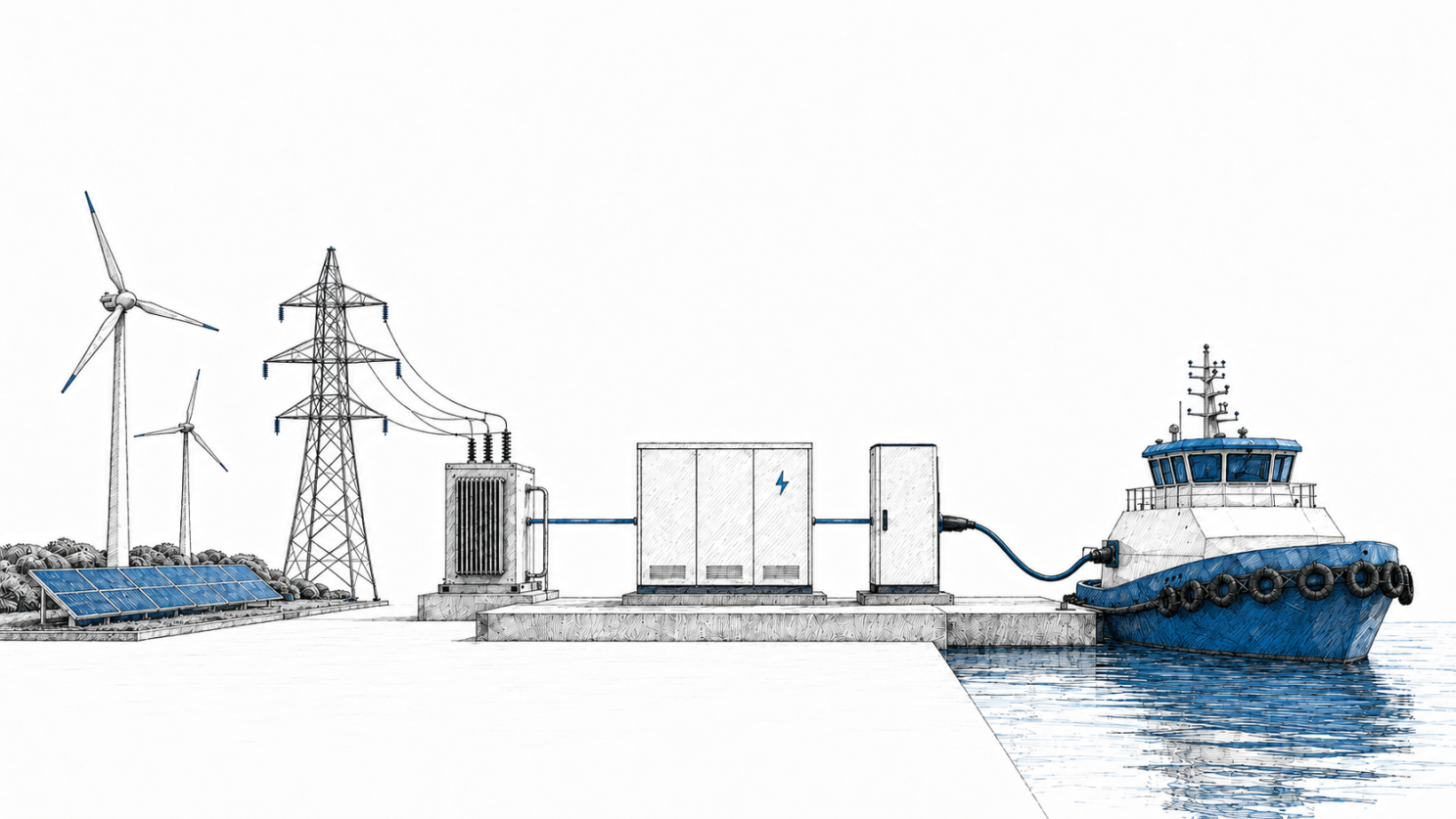
But the economics of electrification are not determined by the vessel alone. What happens on shore matters just as much.
If charging infrastructure cannot earn an adequate return, it will not get built. If it earns that return by making electricity too expensive, vessel electrification may struggle to compete with diesel or other fuels.
That tension sits underneath many maritime electrification projects.
The wholesale price is not the charging price
Electricity looks extremely attractive when compared with marine fuel on a simple energy basis.
In Australia, wholesale electricity has commonly traded around $80-100/MWh, equivalent to around 8-10 cents per kWh.
At those prices, the underlying energy economics for electric vessels are compelling.
But that is not the price a vessel ultimately pays.
Between the electricity market and the vessel sit network charges, retail costs, the grid connection, charging infrastructure and the cost of developing and operating the site.
By the time those costs are included, electricity that starts at 8-10 cents per kWh can readily become a charging price of 40-60 cents per kWh.
The electricity was cheap. The delivery was not.
What electrification is competing with
The relevant comparison is not simply electricity versus diesel at the wholesale level.
At around $2 per litre, diesel equates to roughly $500/MWh of useful energy at the propeller, once engine efficiency is taken into account.
Electric operation also carries battery costs over the life of the vessel.
This means there is a limit to how much can be added to the cost of electricity before the operating-cost advantage of electrification begins to disappear.
The question is therefore not whether electricity is cheaper than diesel.
It is whether electricity can be delivered to the vessel cheaply enough.
Maritime has a utilisation problem
This becomes particularly challenging in maritime because charging loads can be very large but intermittent.
A vessel might require several megawatts of power for a relatively short period. The supporting infrastructure still has to be capable of meeting that peak demand, even if it is lightly used for much of the day.
Shore power can face the same issue. A substantial electrical connection may only be required while a vessel is alongside. Low utilisation matters because the fixed cost of the infrastructure has to be recovered across the energy actually delivered.
The result is a simple commercial problem: infrastructure sized for the peak can become expensive when it is only used for a fraction of the time.
Building a big plug doesn’t work
A conventional approach is to size the grid connection and charging infrastructure around the vessel’s maximum demand, then recover those costs through charging.
For many maritime applications, that can result in expensive infrastructure with relatively low utilisation.
The shore-side system therefore needs to be considered as part of the overall commercial model for electrification, rather than simply as a charger attached to a berth.
There are multiple ways to improve the economics, depending on the vessel, site and local energy market. The important point is that the infrastructure needs to be designed for commercial performance as well as technical capability.
That is where the economics can start to look very different.
The shore side matters
The technology required to electrify many vessel types already exists, and the range of viable applications continues to expand.
Increasingly, the challenge is delivering the supporting energy infrastructure in a way that is reliable, scalable and commercially viable.
At Oceon, that is where we are focused: developing the energy infrastructure needed to support maritime electrification at scale.
The opportunity is not simply to build bigger chargers. It is to make maritime electrification work commercially.